
Crib wall construction is a proven method for building retaining structures with interlocking members that form cells filled with soil or stone. This gravity-based system, with roots in Roman engineering, is still used for slope stabilization, road support, and landscape terracing.
Key steps for successful crib wall construction:
Common crib wall dimensions:
I’m Scott McLeod, owner of McLeod Landscaping. With over three decades of experience in the Merrimack Valley, I’ve overseen hundreds of retaining wall projects, including many crib wall construction installations. Understanding the fundamentals of this method will help you make informed decisions for your property.
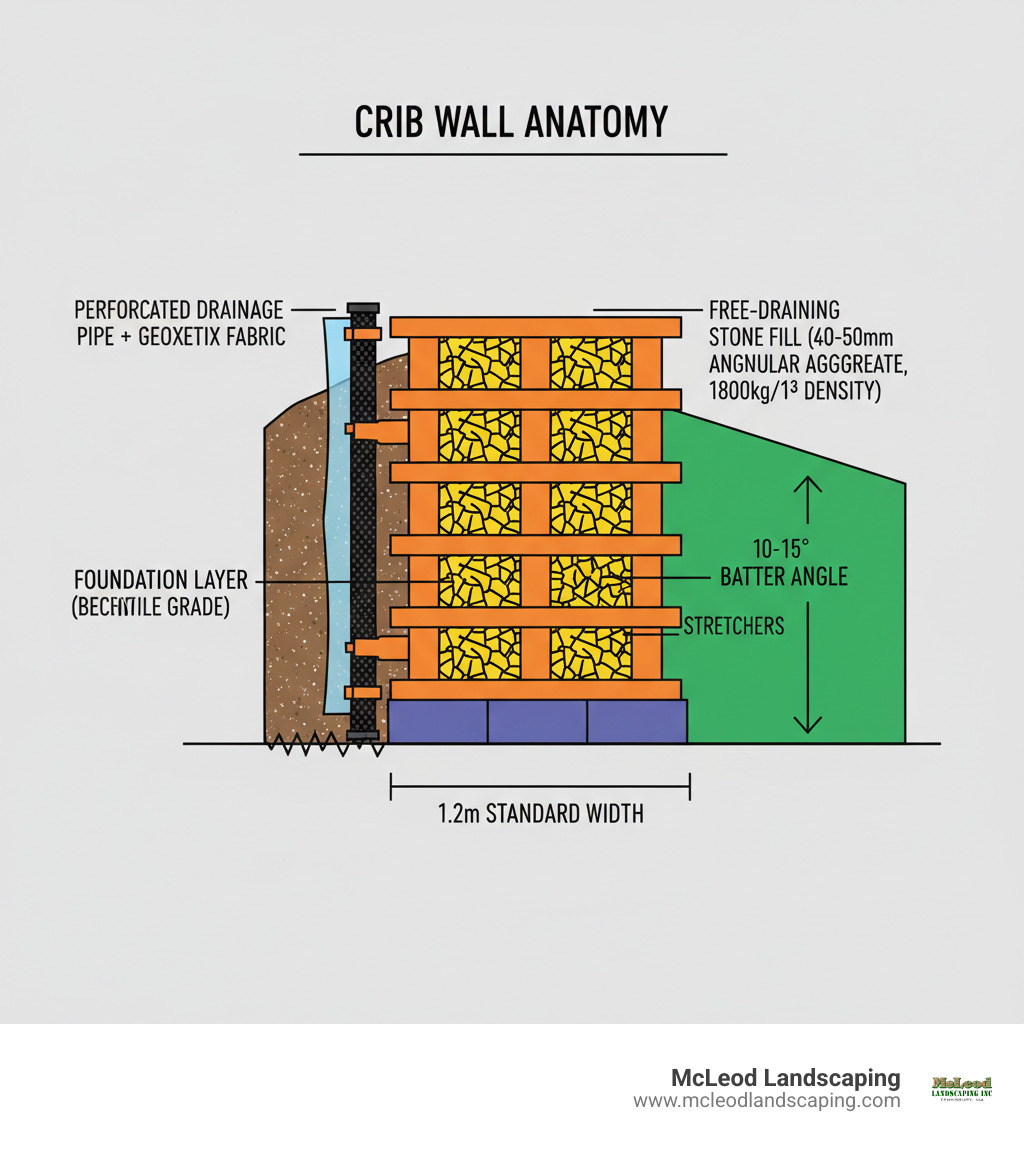
Crib wall construction word guide:
A crib wall is a box-like structure of interlocking beams (wood or concrete) with cells filled with stone or soil. It’s a reliable way to hold back earth on a slope.
As a gravity retaining wall, it uses its own mass and the weight of its fill to resist soil pressure. Its strength comes from an interlocking cell structure of horizontal members (stretchers) and perpendicular members (headers) that tie the structure together.
The design is ancient, with historical origins in Roman bridges over 2,000 years old. Its longevity proves its effectiveness. Today, its primary purposes include slope stabilization, road support, and trail construction across challenging terrain.
Crib walls are appealing because they flex with ground movement, making them ideal for less stable soil. They are proven workhorses that adapt to the natural landscape, unlike rigid concrete walls.
If you’re curious about how crib walls fit into the broader picture of retaining structures for your property, our guide on landscape wall construction provides helpful context.
To decide if a crib wall is the right solution for your project, you need to understand its core principles, the materials involved, and how it stacks up against other retaining wall systems. Let’s explore what makes these structures work and help you determine if they’re the best fit for your landscape needs.
Crib wall construction offers flexibility in materials, each with distinct advantages based on aesthetics, budget, and site demands.
Timber cribs use structural-grade wood like Douglas fir, cedar, or larch, typically in 8×8 inch sizes. For longevity, timber is pressure-treated, though even untreated wood can last 50-60 years with excellent drainage. Its rustic aesthetic is popular for residential projects and blends well in natural environments. If you’re drawn to this option, our guide on landscape timber retaining walls offers additional insights.
Concrete cribs use interlocking precast elements for superior durability and fire resistance. Dating back to the early 20th century, these systems can be dyed in earthen colors to blend into the landscape. Modern systems feature elements light enough for manual handling (around 106 pounds), making them ideal for sites with restricted access.
Steel bin walls are a related system using galvanized steel panels bolted into bins and filled with rock. They operate on similar gravity principles and are used for demanding civil engineering projects due to their exceptional strength.
Understanding the trade-offs of crib walls can help you determine if they’re the best fit for your needs. Please note that any cost comparisons mentioned are based on broad industry averages from online sources and do not reflect pricing for McLeod Landscaping. Project costs can vary significantly.
| Feature | Crib Walls | Concrete Block Walls | Gabion Walls |
|---|---|---|---|
| Cost | Moderate initial cost; materials readily available | Higher material cost; requires skilled labor | Lower material cost; can use local stone |
| Flexibility | Excellent; tolerates ground movement and settlement | Rigid; susceptible to cracking with movement | Excellent; very flexible structure |
| Aesthetics | Natural appearance; can be “living walls” with vegetation | Clean, formal look; limited texture | Rustic, natural; highly textured |
| Lifespan | 50+ years with proper drainage (timber); longer for concrete | 50-100 years with proper construction | 50-100+ years; improves as vegetation establishes |
Key advantages include excellent drainage due to the open structure, which prevents hydrostatic pressure. They are a flexible system, tolerating ground settlement better than rigid walls. Aesthetically, they can be planted as “living walls.” The components are also suitable for remote access sites, as they can be transported without heavy equipment.
However, there are limitations. Crib walls have height restrictions (typically 8-13 feet for a single wall). They require specific fill material—free-draining angular stone (40-50mm)—not just any soil. The structure can also be susceptible to damage from impact or vandalism.
At McLeod Landscaping, we’ve built countless retaining structures over three decades and can guide you toward the solution that best fits your property and budget.
A crib wall is a gravity retaining wall that resists lateral earth pressure through its mass. Its unique design features an interlocking cellular structure of horizontal stretchers and vertical headers. These cells are filled with stone or soil, and the combined weight of the frame and fill provides stability to prevent erosion.
This construction method is ancient and proven, with evidence of crib walls in Roman bridges over 2,000 years old, demonstrating its enduring effectiveness.
Today, the primary purposes remain consistent: slope stabilization, supporting roads and trails, and retaining cuts and embankments. Their open structure allows for excellent drainage and can support vegetation, making them ideal for projects where environmental integration is important.
If you’re exploring how these structures might fit into your overall landscape vision, our comprehensive guide on landscape wall construction provides additional context and options.
To decide if a crib wall is the right solution for your project, it’s crucial to understand its core principles, the materials involved, and how it stacks up against other retaining wall systems.
Crib walls can be constructed from various materials, each offering distinct advantages depending on aesthetics, cost, and project demands.
Timber cribs use strong, decay-resistant wood like Douglas fir, cedar, or larch, typically in 8×8 inch dimensions. While pressure-treatment extends their lifespan, even untreated timber can last 50-60 years with proper drainage. The rustic look of wood is a major aesthetic asset, blending naturally into the landscape. If you’re drawn to the charm of wood, our guide on landscape timber retaining walls explores this option in greater depth.
Concrete cribs feature interlocking precast concrete elements, offering superior durability and fire resistance. Modern systems like Criblok use components weighing around 106 pounds, allowing for manual installation on sites with limited access. The concrete can be dyed in earthen colors for a more natural appearance.
Steel bin walls, while not strictly crib walls, are a related gravity structure using galvanized steel panels bolted into bins and filled with rock. Their exceptional strength makes them suitable for demanding civil engineering projects.
Like any construction method, crib walls come with their own set of strengths and limitations. Please note that any cost comparisons mentioned are based on broad industry averages from online sources and do not reflect pricing for McLeod Landscaping. Project costs can vary significantly.
| Feature | Crib Walls | Concrete Block Walls | Gabion Walls |
|---|---|---|---|
| Cost | Moderate to high (materials + labor intensive) | Moderate (standardized units) | Moderate (wire baskets + stone fill) |
| Flexibility | Excellent—tolerates settlement well | Limited—rigid structure | Good—flexible mesh adapts to movement |
| Aesthetics | Versatile—natural wood, colored concrete, can be planted | Clean, uniform appearance | Rustic, natural stone look |
| Lifespan | 50+ years (timber with treatment); 75+ years (concrete) | 50-100 years (depends on quality) | 50-75 years (wire longevity varies) |
Advantages are numerous. Their open structure provides excellent drainage, preventing the buildup of hydrostatic pressure that can destroy solid walls. They are a flexible structure that tolerates ground settlement without cracking. Aesthetically, they can be planted to create “living walls,” a true Nature-Based Solution (NBS). Lightweight components also make them ideal for remote locations with limited equipment access.
Key limitations include height restrictions, with single walls typically limited to 8 to 13 feet. Taller structures require terracing. They also require specific fill material—hard, angular stone (40-50mm) with a mass of approximately 1800kg/m³, not just any soil. Finally, the structure can be susceptible to damage from vandalism or impacts in high-traffic areas.
Proper engineering and planning are the foundation of a successful project. This section details the crucial calculations and material choices needed to ensure your wall stands the test of time.
A crib wall’s stability relies on gravity wall principles to resist lateral earth pressure. Key design factors include:
Proper drainage and backfill are critical for longevity. While crib walls have good natural drainage, a dedicated system is best practice.

This guide breaks down the building process into manageable steps, from breaking ground to the final touches, ensuring a professional-quality result.
First, clear and excavate the site to the required depth for the foundation. Creating a level base is crucial for the wall’s stability. Pour a reinforced concrete footing, using formwork to establish the correct initial batter angle (typically 1H:4V). If you’re working on sloped terrain, our guide on building a retaining wall on a slope offers additional insights.
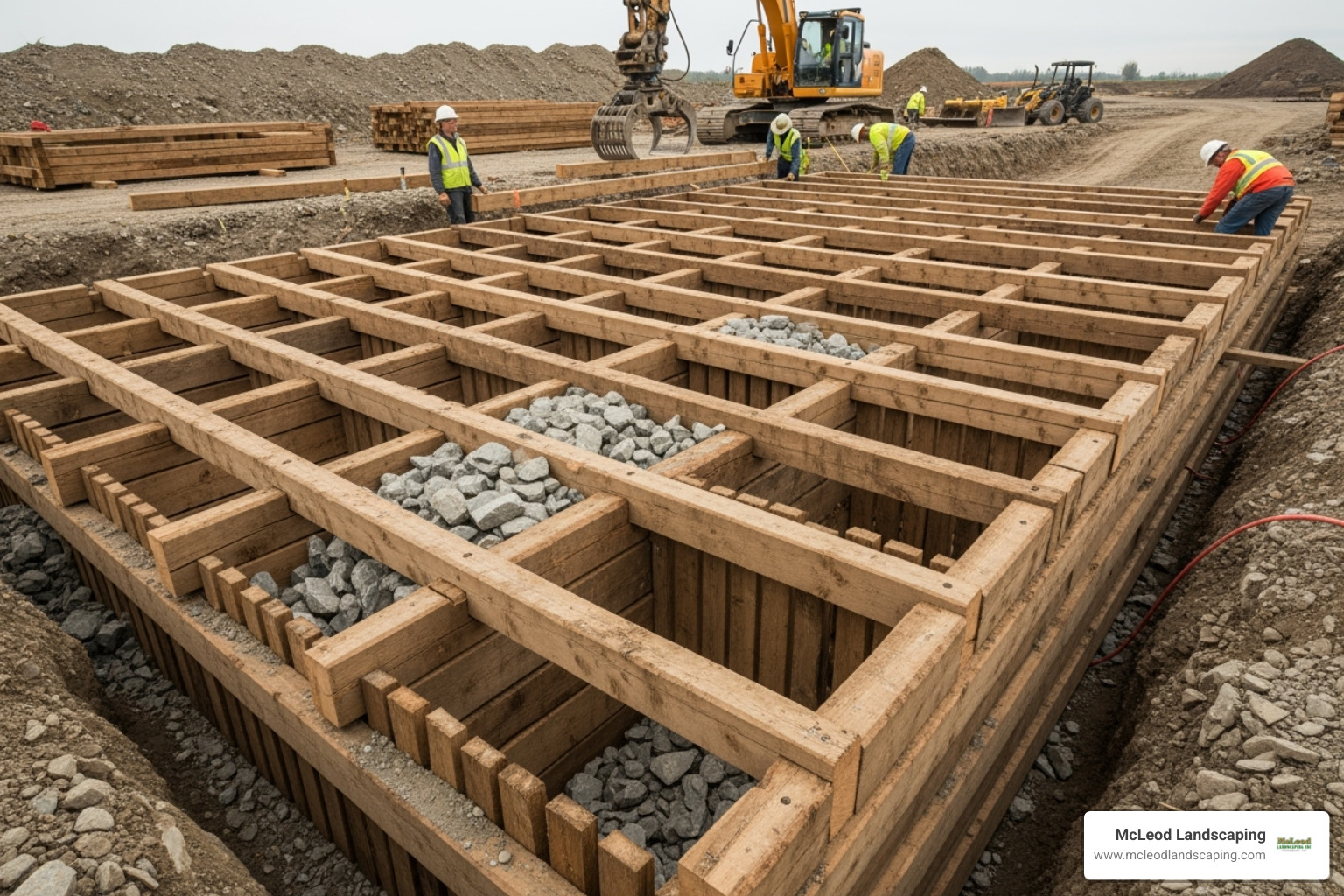
Lay the first course of stretchers (parallel members) on the foundation, ensuring they are perfectly level and aligned. Add the next layer of headers (perpendicular members) to create the interlocking pattern. Continue building in alternating layers, regularly checking the wall’s alignment and batter angle to maintain consistency.
This process occurs as you build. After the first few courses, install the perforated drainage pipe wrapped in geotextile fabric behind the wall. As you add each layer of the crib structure, fill the internal cells with the specified angular stone (40-50mm). Simultaneously, place and compact backfill material in 8-10 inch layers behind the wall. This concurrent process provides immediate stability. Use only the specified fill material, avoiding native soil or organic matter.
Once you’ve mastered the basics, crib wall construction opens up exciting possibilities beyond simple earth retention. These structures can become living, breathing parts of your landscape while handling even the most challenging terrain.
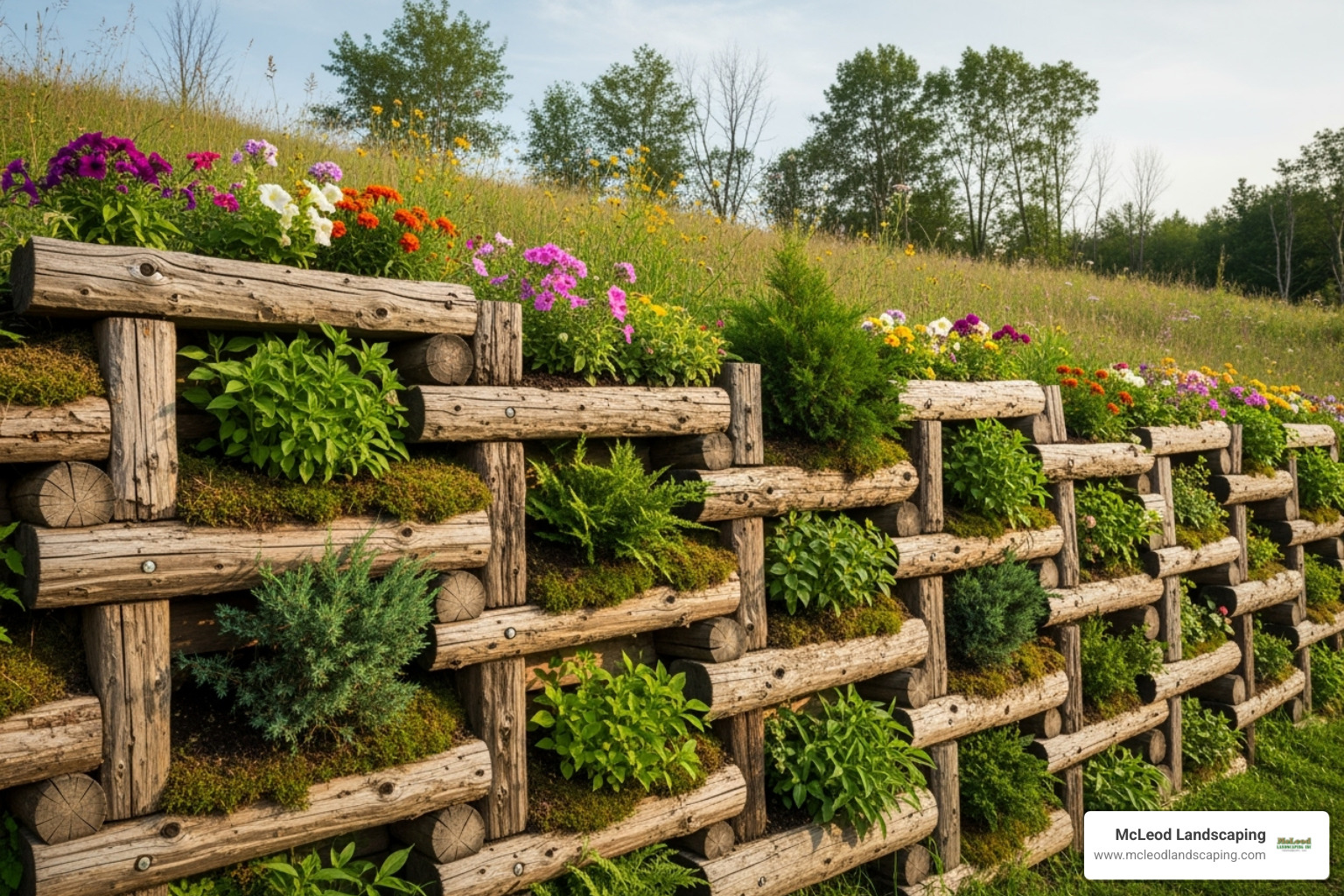
Crib walls can be transformed into “living walls” by using the cellular structure as planting pockets. This is more than aesthetic; as plants grow, their root systems reinforce the soil, adding long-term stability. This approach aligns with modern Nature-Based Solutions (NBS), creating a structure that contributes to the local ecosystem. Select plants with strong, fibrous roots, and consider designs like the Krainer wall (a double crib wall) for improved planting and load-bearing capacity. Our guide on hardscape vs softscape explores this balance in detail.
Crib walls are highly adaptable for difficult sites where rigid systems might struggle.
A single-depth crib wall is generally limited to 8-13 feet in height, depending on the design and site conditions. For taller applications, terraced walls are used, where multiple tiers are built, each typically under 6.5 feet (2 meters). Double-width cribs can also be used for greater height and stability.
Yes, for any wall over 3-4 feet high or supporting a critical load (like a driveway), you should consult a qualified geotechnical engineer. They perform essential calculations for stability (sliding, overturning, etc.) and design for your specific soil conditions. The upfront cost of professional engineering is a small investment compared to the cost of fixing a failed wall. For complex projects in the Merrimack Valley, we always partner with qualified engineers to ensure every aspect of the crib wall construction meets safety standards.
The lifespan depends on the material and drainage provided.
Regardless of material, the keys to maximizing longevity are proper design, correct material selection, and excellent drainage.
Mastering crib wall construction means understanding how gravity, drainage, and soil mechanics create a lasting structure. Combining these principles with quality materials and precise installation results in a retaining wall that is both functional and beautiful.
In my three decades in the Merrimack Valley, I’ve seen many crib wall construction projects transform difficult slopes into functional landscapes. It’s especially satisfying when vegetation integrates with the structure, making it part of the natural environment.
The key to success is simple: don’t cut corners on design or drainage. Proper planning, a solid foundation, and quality backfill are essential for a wall that will last for generations.
For complex projects—anything over 4 feet tall, walls supporting critical loads, or sites with challenging soil conditions—partnering with experienced professionals makes all the difference. McLeod Landscaping has spent over 30 years building durable and beautiful retaining wall installations for residential and commercial clients across Andover, Billerica, Burlington, Carlisle, Chelmsford, Concord, Lowell, Tewksbury, Westford, Wilmington, and the surrounding Merrimack Valley communities.
We bring our comprehensive understanding of both hardscaping and the local soil conditions to every project. Whether you’re stabilizing a riverbank, terracing a steep backyard, or creating a living wall that will grow more beautiful each year, we’re here to ensure your investment stands strong for decades to come.
Contact McLeod Landscaping today at (978) 640-0957 or click here to schedule a consultation for retaining wall installation. Let our experienced team design and install a functional and visually appealing retaining wall that enhances your landscape.


1881 Main St Unit 1, Tewksbury, MA 01876