
When a retaining wall shows signs of wear, it’s more than an eyesore. Retaining wall repair is crucial for the safety and stability of your landscape, as ignoring minor issues can lead to dangerous problems.
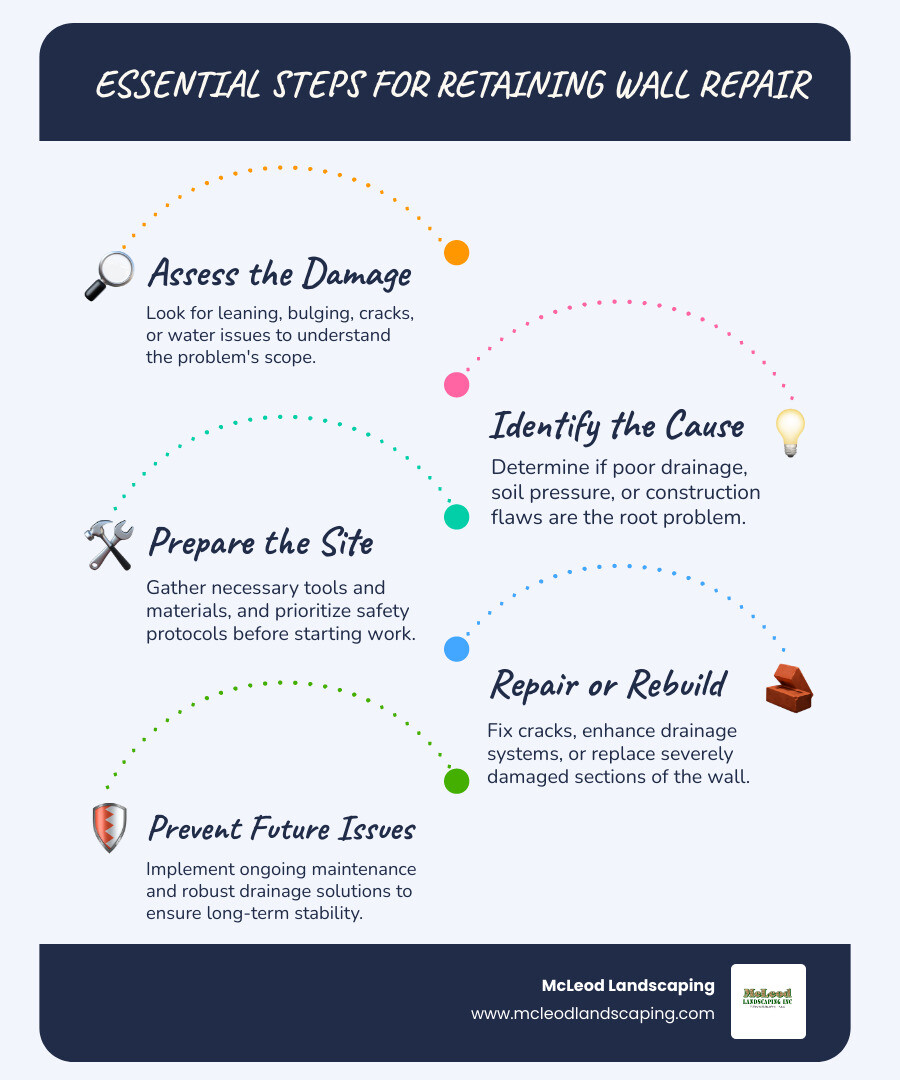
Here are the essential steps for addressing retaining wall damage:
Retaining walls hold back tons of soil to prevent erosion and create usable space. However, constant pressure from soil and water can cause them to fail, leading to property damage or injury. Addressing problems early saves hassle and expense.
I’m Scott McLeod, owner of McLeod Landscaping Inc. With over three decades of experience, my team has tackled countless hardscaping projects, including complex retaining wall repair. We’re dedicated to ensuring your outdoor spaces are both beautiful and structurally sound.
Before diving into how to fix a retaining wall, you need to know what to look for. A failing wall can cause serious property damage and become a safety hazard. Catching these early warning signs can prevent a minor fix from turning into a major overhaul.
Keep an eye out for these common distress signals:
Ignoring these signs can lead to more expensive problems. A proactive approach to retaining wall repair is always the smartest strategy.

Understanding why a wall is failing is key to a lasting repair. The most common culprits often work in combination.
When we approach a retaining wall repair, our first step is to find the root cause. For more ways we can help with your outdoor spaces, please explore our hardscaping services.
Different retaining walls have unique construction and repair needs. The type of wall you have will determine the best fix.
Our experience across the Merrimack Valley means we understand the quirks of these different structures and know how to restore them.

Homeowners often ask if they can handle retaining wall repair themselves. The answer is, “it depends.” While some minor fixes are possible, a lack of understanding of earth retention, soil compaction, and drainage can lead to bigger problems. It’s crucial to know when to DIY and when to call the experts.
This guide can help you decide:
| Scenario | DIY Feasible? | Professional Recommended? |
|---|---|---|
| Wall Height | Under 3-4 feet | 4 feet or higher |
| Severity of Lean | Minor (<1-2 inches) | Severe (>2 inches) or sudden |
| Type of Damage | Loose blocks, minor cracks, clogged drainage | Major bulges, structural cracks, crumbling, rot |
| Wall Type | Dry-stacked stone, segmental block (minor) | Cantilevered, MSE, gabion, complex timber, mortared |
| Underlying Cause | Surface drainage, minor settlement | Hydrostatic pressure, soil instability, foundation |
| Tools Required | Basic hand tools, level, shovel | Heavy equipment, specialized tools, engineering plans |
| Permits Required | Unlikely | Likely (check local codes) |
For homeowners in the Merrimack Valley, knowing the difference between a DIY task and a pro-level job is key.
DIY-friendly problems are typically minor issues on walls under 4 feet tall. This includes fixing a few loose blocks in a segmental wall, patching hairline cracks, or clearing clogged drainage pipes. These tasks are manageable if the wall’s overall structure is sound.
Pro-level problems require an expert. Call a professional for any wall over 4 feet tall, or for walls showing severe distress like a lean of more than 2 inches, large structural cracks, or widespread bulging. Issues caused by deep-seated problems like hydrostatic pressure or foundation failure demand professional engineering and construction knowledge. For guidance on proper installation techniques, you can learn about proper installation.
If you’re ever unsure, it’s safest to consult with a professional. We offer free consultations to assess the damage and recommend the best course of action for your retaining wall repair needs in Lowell, Concord, or elsewhere in our service area.
Deciding between repair and replacement often comes down to cost versus the severity of the damage. While repairs can be affordable, sometimes replacement is the more cost-effective long-term solution, especially if the root cause is significant.
Costs are influenced by:
Based on national averages, minor retaining wall repair might cost $500 to $2,500. Moderate repairs could range from $2,500 to $10,000, while major repairs or partial rebuilds can cost $7,500 to $30,000 or more. Please remember these are average costs based on internet data and not actual costs for McLeod Landscaping. We provide custom quotes for your specific project.
Choose repair if:
Consider replacement if:
Before starting any significant retaining wall repair, you must check local building codes and permit requirements in your town, whether it’s Tewksbury, Chelmsford, or elsewhere in the Merrimack Valley.
Our team can help guide you through these requirements to ensure your project is fully compliant.
For minor issues on segmental block walls under 4 feet, a DIY approach to retaining wall repair can be feasible, but be aware that this is labor-intensive work. This guide focuses on a common repair for a leaning block wall. If you don’t understand geotechnical issues like soil compaction and drainage, you might only be applying a temporary fix.
Gather everything you need before you begin to avoid multiple trips to the hardware store.
Here’s how to fix a leaning section of a segmental block wall where the base or drainage has failed.
Step 1: Mark the Repair Area. Use spray paint to outline the section to be repaired on top of the wall. Plan to remove blocks in an inverted “V-shape” down to the ground to maintain stability in adjacent sections.
Step 2: Prepare the Site. Lay a tarp in front of the wall to protect your lawn. Clear an area behind the wall to neatly stack the blocks you remove.
Step 3: Remove Blocks Carefully. Start at the top of the “V,” removing the cap blocks first, then work your way down. Clean off old adhesive and stack the blocks in order for easier reassembly.
Step 4: Excavate Backfill. Dig out all the old backfill material behind the removed blocks, down to the base. Dispose of any contaminated soil, sand, or old gravel.
Step 5: Fix the Base and Drainage. This is the most critical step. First, address the root cause of the failure (e.g., a tree root, poor surface drainage). Then, dig down to create a new base, laying and compacting about 8 inches of 3/4-inch drainage stone topped with 2 inches of paver base. Ensure this new foundation is perfectly level. Install a 4-inch perforated drain tube (holes down) wrapped in geotextile fabric at the base.
Step 6: Rebuild the Wall Course by Course. Lay the first course of blocks on the new level base. As you add subsequent courses, stagger the joints. After each course, backfill behind it with at least 12 inches of 3/4-inch clear drainage rock and compact it lightly.
Step 7: Backfill and Compact. Continue rebuilding to the top. Secure the capstones with masonry adhesive, ensuring they are staggered over the seams below. Then, step back and admire your stable, newly repaired wall.

We cannot overstate this: proper drainage is the key to a long-lasting retaining wall repair. The primary cause of wall failure is hydrostatic pressure—the immense force of water-saturated soil pushing against the wall. An effective drainage system eliminates this pressure.
By focusing on drainage, you’re not just fixing the current problem—you’re preventing it from happening again. For comprehensive water management solutions, consider our irrigation system services.
It’s normal to have questions about retaining walls. They are complex structures that do a lot of hard work. Here are some of the most common inquiries we receive about retaining wall repair.
An ounce of prevention is worth a pound of cure. Proactive steps can extend your wall’s life and prevent major headaches.
Timing is key for an effective repair. We recommend tackling these projects when the ground is dry, making late spring or summer the ideal time. Dry soil is lighter, easier to excavate, and allows for proper compaction of new backfill. Avoid wet seasons, as saturated soil is heavy, unstable, and can make the work dangerous and less effective. Moderate temperatures are also better for any mortar or adhesives to cure properly.
This depends on the severity of the lean. More often than not, a partial or full rebuild is the only long-lasting solution.
For a minor lean (less than 1-2 inches) on a structurally sound wall, specialized techniques like installing tie-backs or anchors can sometimes stabilize it. However, this may not fully correct the lean and can affect the wall’s appearance.
For a significant lean (more than 2 inches), bulging, or cracking, a rebuild is almost always necessary. A severe lean indicates a fundamental failure of the foundation or drainage system. Simply pushing the wall back is a temporary fix that doesn’t address the root cause.
The advantage of a rebuild is that it allows for a proper foundation, modern drainage, and durable materials to be installed correctly, providing a safe, long-term solution. If you have a leaning wall in the Merrimack Valley, we recommend a professional assessment to determine the safest and most cost-effective path forward for your retaining wall repair.
We’ve covered the essentials of retaining wall repair, from spotting warning signs to the step-by-step process for a minor fix. The key takeaways are to address problems early, ensure proper drainage, and know when to call for professional help. A failing retaining wall is more than an eyesore—it’s a risk to your property and safety.
While some minor repairs are suitable for a DIY approach, the complexities of soil pressure and drainage systems often require professional expertise. For walls over 4 feet tall, or those with severe damage like major leaning or structural cracks, bringing in professionals is a smart investment in your property’s long-term health.
At McLeod Landscaping, we have been solving these exact problems for homeowners and businesses throughout the Merrimack Valley for over 30 years. Our team doesn’t just patch problems; we identify the root cause and fix it right the first time to ensure quality and durability.
Your landscape deserves a permanent solution, not a temporary patch. Don’t wait for a small problem to become a major one. View our retaining wall installation services to see how we can restore stability and beauty to your outdoor space, and let’s work together to keep your property safe and functional for years to come.
Contact McLeod Landscaping today at (978) 640-0957 or click here to schedule a consultation for retaining wall installation. Let our experienced team design and install a functional and visually appealing retaining wall that enhances your landscape.


1881 Main St Unit 1, Tewksbury, MA 01876