
Ice control services are professional solutions that prevent and remove ice formation on walkways, parking lots, driveways, and other property surfaces to ensure safe access and reduce liability risks. These services use specialized equipment, trained crews, and strategic application of de-icing materials to keep properties accessible during winter weather conditions.
Key Ice Control Service Components:
Winter weather can shut down businesses and create serious safety hazards in minutes. Even small amounts of ice can lead to slip-and-fall accidents, with commercial properties facing average injury claims ranging from $20,000 to $150,000 per incident.
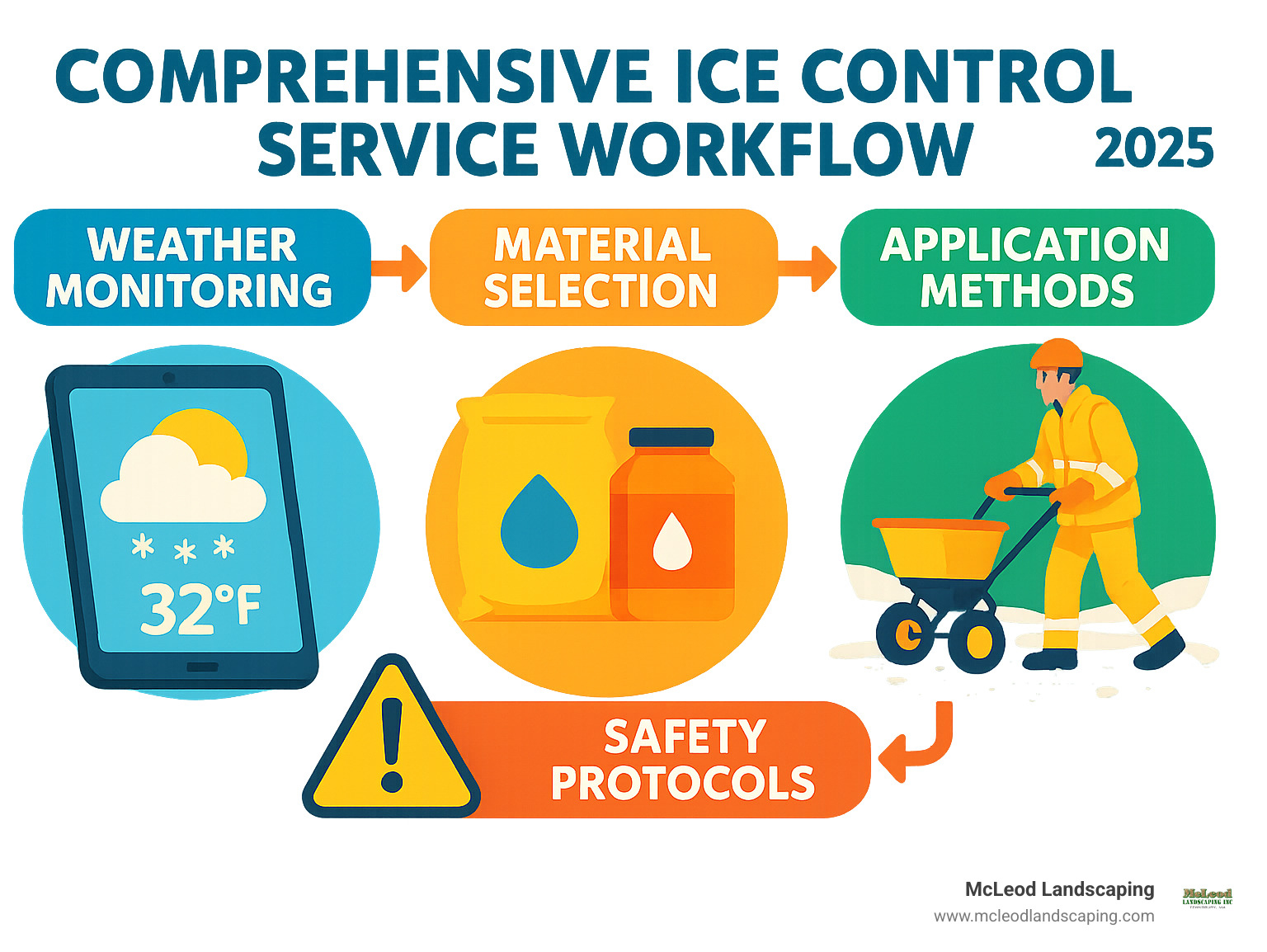
Professional ice control goes beyond throwing salt on icy surfaces. It involves proactive weather monitoring, strategic material selection, and precise application techniques that address different temperature ranges and surface types. Companies use everything from traditional rock salt (effective to 20°F) to calcium chloride (working down to -25°F) depending on conditions.
I’m Scott McLeod, owner of McLeod Landscaping, and I’ve spent over three decades providing comprehensive ice control services to commercial and residential properties throughout the Merrimack Valley. Our team has developed proven systems for keeping over 200 properties safe and accessible during New England’s harshest winter conditions.
Quick Ice control services terms:
Ice control services encompass professional solutions designed to prevent ice formation and remove existing ice from property surfaces. These services are critical for maintaining safe access to commercial facilities, residential properties, and public spaces during winter weather conditions.
At its core, ice control involves strategic planning, material selection, and precise application techniques to address the unique challenges each property faces. We work with corporate office parks, retail centers, hotels, healthcare facilities, HOA communities, apartment buildings, colleges, and government facilities throughout the Merrimack Valley.
Commercial properties face significant liability risks when ice accumulates on walkways, parking lots, and entryways. Even minor ice formations can create slip-and-fall hazards that result in serious injuries and costly legal claims. Professional ice control services help properties maintain compliance with local regulations and industry standards. The Snow and Ice Management Association (SIMA) provides industry standards and best practices that guide professional ice control operations.
Ice formation occurs through several mechanisms that create different types of hazards on property surfaces. The most common ice formation happens during freeze-thaw cycles. When temperatures fluctuate around the freezing point, melted snow and ice refreeze into dangerous sheets of ice.
Black ice presents the most insidious hazard. This thin, nearly invisible layer of ice forms when moisture freezes on pavement surfaces, creating extremely slippery conditions that are difficult to detect. Black ice typically develops during early morning hours when temperatures drop after a warm day.

The problem extends beyond simple slip hazards. Ice accumulation can damage concrete and asphalt surfaces through freeze-thaw expansion, creating larger cracks that require expensive repairs.
Professional ice control begins with detailed site assessments and risk audits during the fall season. We map each property to identify high-priority areas like main entrances, emergency exits, ADA-compliant pathways, and heavily trafficked pedestrian zones.
Our 24/7 crews maintain constant readiness throughout the winter season. We subscribe to professional meteorological services that provide detailed forecasts and real-time weather monitoring. When conditions indicate potential ice formation, our teams pre-position equipment and materials for rapid deployment.
Understanding the difference between de-icing and anti-icing is crucial for effective ice control. These two approaches serve different purposes and require different materials, equipment, and timing strategies.
Anti-icing is a proactive approach that involves applying liquid de-icing agents to surfaces before precipitation begins. This preventive treatment creates a barrier that prevents ice from bonding to pavement surfaces. Anti-icing is typically more cost-effective than de-icing because it requires less material and provides longer-lasting protection.
De-icing is a reactive approach used after ice has already formed on surfaces. This process requires more material and energy to break the bond between ice and pavement, making it more expensive and labor-intensive than anti-icing.
Our ice removal company services integrate both approaches based on real-time conditions and property-specific requirements.
Different de-icing materials perform optimally within specific temperature ranges. Understanding these limitations is essential for selecting the right product for current conditions.
Rock salt (sodium chloride) remains the most commonly used de-icing material due to its effectiveness and cost-efficiency. Rock salt works reliably down to approximately 20°F (-7°C), making it suitable for most winter conditions in the Merrimack Valley.
Calcium chloride provides superior performance in extremely cold conditions, maintaining effectiveness down to -25°F (-32°C). This material is hygroscopic, meaning it absorbs moisture from the air to create brine solutions that accelerate ice melting.
Magnesium chloride offers excellent performance down to 5°F (-15°C) while being gentler on vegetation, concrete, and metal surfaces compared to other de-icers.
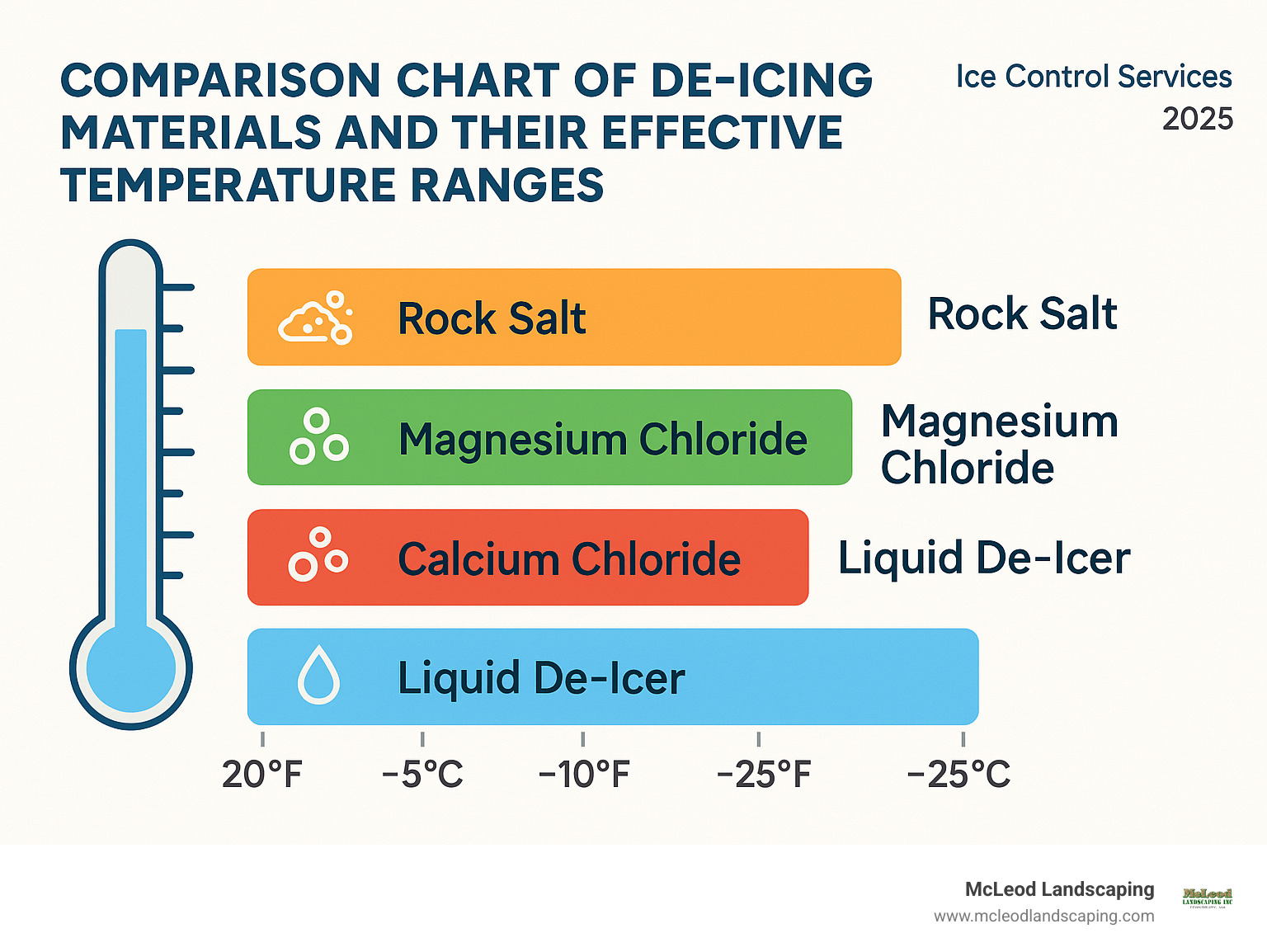
Liquid de-icers typically use brine solutions made from these same materials but provide more precise application and faster activation. Sand doesn’t melt ice but provides traction on icy surfaces.
Environmental considerations play an increasingly important role in ice control decisions. Traditional de-icing materials can impact vegetation, water systems, and pet safety when not used properly.
Urea-based ice melts provide the safest option for areas where pets and children play. Urea is less harmful if ingested and causes minimal irritation to paw pads. However, urea requires higher application rates and excessive use can damage turf when spring arrives.
Magnesium chloride offers the best balance of effectiveness and environmental safety among chloride-based de-icers. This material causes less damage to vegetation and concrete while maintaining good ice-melting performance.
Precision application reduces environmental impact regardless of material choice. Using brine solutions instead of bulk salt allows for more accurate application rates and reduces the total amount of chemicals needed.
The safety and liability benefits of professional ice control services extend far beyond simple slip prevention. Property owners face significant legal and financial risks when ice-related accidents occur on their premises.
Slip-and-fall accidents represent one of the leading causes of premises liability claims during winter months. Commercial properties can face injury claims ranging from $20,000 to $150,000 per incident when ice-related accidents occur. These costs include medical expenses, legal fees, settlement payments, and potential increases in insurance premiums.
Professional ice control services help properties maintain compliance with OSHA standards and local regulations. Insurance companies increasingly recognize the value of professional ice control services, with many insurers offering premium discounts for properties that maintain contracts with certified ice control providers.
Our certified crews maintain detailed electronic logs of all ice control activities, including application times, materials used, weather conditions, and photographic documentation. This record-keeping provides crucial evidence in the event of liability claims.
Professional ice control services dramatically reduce accident rates compared to DIY approaches or delayed response strategies. The key factors include proactive monitoring, rapid response capabilities, and systematic coverage of all pedestrian areas.
Pedestrian zones require special attention in ice control planning. Areas like building entrances, crosswalks, and transit stops see heavy foot traffic and cannot tolerate any ice accumulation.
ADA compliance mandates that accessible pathways remain safe and usable for individuals with disabilities. Ice accumulation on ADA-compliant routes creates serious safety hazards and potential legal violations.
Our snow plow company near me services integrate ice control with comprehensive winter maintenance to address all aspects of pedestrian and vehicle safety.
Professional weather monitoring forms the foundation of effective ice control services. We subscribe to specialized meteorological services that provide detailed forecasts, real-time conditions, and severe weather alerts specifically designed for snow and ice management operations.
Subscribed forecasts offer much more detail than consumer weather services, including pavement temperatures, precipitation timing, wind patterns, and post-storm conditions. We receive updates every 15-30 minutes during active weather events.
On-site sensors provide real-time data about actual conditions at each property. Pavement temperature sensors, moisture detectors, and wind gauges help us make precise decisions about treatment timing and material selection.
Standby teams maintain 24/7 readiness throughout the winter season. Our crews can deploy within 30 minutes of receiving activation orders.
The financial consequences of inadequate ice control far exceed the cost of professional services. Average claim costs for slip-and-fall accidents range from $20,000 to $150,000 per incident, with severe injuries potentially resulting in much higher settlements.
Reputational harm can be even more costly than direct financial losses. Businesses that experience multiple ice-related accidents may face negative publicity and long-term damage to their reputation.
The math is straightforward: professional ice control services cost a fraction of a single serious accident claim.

Selecting the right ice control partner involves understanding different contract structures and evaluating providers based on their capabilities, experience, and service approach.
Per-event contracts charge for each individual ice control application. This approach works well for properties in areas with infrequent ice events but can become expensive during active winter seasons.
Seasonal contracts offer fixed pricing for unlimited ice control services throughout the winter season. This approach provides the most predictable budgeting and ensures that cost concerns never delay necessary safety treatments.
Zero-tolerance contracts guarantee immediate response and continuous ice-free conditions for critical areas. These premium service agreements are essential for facilities like hospitals and emergency services.
Our commercial snow plowing services integrate ice control with comprehensive winter maintenance to provide seamless protection throughout the season.
When preparing RFPs for ice control services, include detailed property maps, historical weather data, specific performance requirements, and response time expectations. Look for providers with SIMA certification and ASCA credentials that demonstrate commitment to industry best practices.
Ice control pricing varies significantly based on property size, service requirements, geographic location, and contract structure. These figures represent average costs based on internet research and are not actual pricing for McLeod Landscaping services.
Per-application pricing typically ranges from $75 for small properties to over $1,500 for large complexes, with average-sized commercial properties ranging from $150 to $450 per treatment.
Seasonal contracts generally range from $1,000 for small properties to over $25,000 for large facilities, with typical commercial properties ranging from $2,000 to $8,000.
Hourly rates for ice control services typically range from $75 to $400 per hour for equipment and operator, depending on equipment type and emergency response requirements.
Insurance verification should include general liability coverage of at least $1 million per occurrence, commercial auto insurance, and workers’ compensation coverage.
Equipment inventory should include appropriate spreaders, brine application systems, and backup equipment to ensure service continuity.
Response time guarantees should specify exactly when ice control treatments will begin after different types of weather events.
Documentation systems should include detailed service logs, photographic records, weather condition reports, and material usage tracking.
References from similar properties provide insight into the provider’s actual performance and customer satisfaction.
Effective ice control requires integration with comprehensive winter property maintenance planning. Integration planning should address how ice control services coordinate with snow plowing, sidewalk clearing, and facility access requirements.
Our winter property maintenance services provide comprehensive planning and coordination to ensure all aspects of winter safety work together seamlessly.
The ice control industry continues to evolve with new technologies and sustainable practices that improve effectiveness while reducing environmental impact.
Liquid brine precision represents one of the most significant advances in ice control technology. Brine solutions provide more accurate application rates, faster activation, and better surface coverage than traditional granular materials. Using brine as a pre-treatment can reduce overall salt usage by up to 30%.
Smart sprayers use GPS guidance and variable rate technology to apply exactly the right amount of material to each area based on pre-programmed application maps.
Pavement sensors embedded in roadways and parking lots provide real-time data about surface temperatures, moisture levels, and chemical residue from previous treatments.
Data analytics help optimize ice control operations by analyzing historical weather patterns, material usage, and service outcomes.

Environmental stewardship in ice control focuses on minimizing chemical usage while maintaining effective safety protection.
Chloride runoff represents the primary environmental concern with traditional ice control methods. We use precision application techniques and alternative materials to minimize chloride loading while maintaining effective ice control.
Best practices include pre-wetting granular materials to improve effectiveness, using liquid anti-icing treatments to reduce total material needs, and calibrating equipment regularly. These practices typically reduce salt usage by 20-40% compared to traditional applications.
Alternative materials like magnesium chloride and calcium magnesium acetate provide effective ice control with reduced environmental impact.
GPS-guided spreaders automatically adjust application rates based on vehicle speed and pre-programmed treatment maps.
Mobile reporting apps allow crew members to document treatments in real-time with GPS coordinates, timestamps, photographs, and weather conditions.
Fleet management systems track vehicle locations, monitor equipment performance, and optimize route planning for maximum efficiency.
De-icing is a reactive process that removes ice after it has already formed on surfaces. This approach requires more material and energy because it must break the bond between ice and pavement.
Anti-icing is a proactive process that prevents ice from forming or bonding to surfaces. This approach uses liquid treatments applied before precipitation begins to create a barrier between moisture and pavement. Anti-icing typically requires 30-50% less material than de-icing.
The timing difference is crucial: anti-icing treatments are applied 2-4 hours before precipitation begins, while de-icing treatments are applied after ice formation is detected.
Pet-safe ice melts do exist, but they require careful selection and proper application. Urea-based ice melts provide the safest option for areas where pets walk regularly. Urea causes minimal paw irritation and is less harmful if ingested compared to chloride-based materials.
However, urea-based ice melts work effectively only down to about 15°F and require higher application rates to achieve the same melting performance as traditional materials.
Magnesium chloride offers the best balance of effectiveness and safety among chloride-based de-icers. It causes less paw irritation than calcium chloride or rock salt and is gentler on vegetation and concrete surfaces.
The key to pet safety involves proper application rates, prompt cleanup of excess material, and providing foot-washing stations where pets enter buildings.
Seasonal contracts provide fixed pricing for unlimited ice control services throughout the winter season. This approach offers predictable budgeting, guaranteed service availability, and elimination of cost concerns during service decisions.
Per-event pricing charges for each individual ice control application. This approach can be cost-effective during mild winters with infrequent ice events, but costs can escalate quickly during active seasons.
The choice depends on your property’s risk profile, budget constraints, and winter weather patterns. High-risk properties like hospitals and retail centers typically benefit from seasonal contracts that guarantee service availability without cost concerns.
Professional ice control services represent a critical investment in property safety, liability protection, and operational continuity during winter weather conditions. The comprehensive approach we’ve outlined provides the multi-layered protection that modern properties require.
Key takeaways include:
The financial mathematics strongly favor professional ice control services. When average slip-and-fall claims range from $20,000 to $150,000 per incident, the cost of professional services represents a small fraction of potential liability exposure.
Safety must remain the primary consideration in all ice control decisions. Professional ice control services provide the expertise, equipment, and responsiveness necessary to maintain safe conditions throughout the winter season.
At McLeod Landscaping, we’ve spent over 30 years developing and refining our ice control systems to provide comprehensive protection for properties throughout the Merrimack Valley. Our integrated approach combines traditional proven methods with innovative technologies to deliver reliable results regardless of winter weather conditions.
Whether you manage a single commercial property or oversee multiple facilities across our service area including Andover, Billerica, Burlington, Carlisle, Chelmsford, Concord, Lowell, Tewksbury, Westford, and Wilmington, our team has the experience and resources to develop customized ice control solutions that meet your specific requirements.
Ready to develop a comprehensive ice control strategy for your property? Contact our snow removal service team to discuss your specific requirements and learn how our proven systems can provide the protection and peace of mind you need throughout the winter season.
Contact McLeod Landscaping today at (978) 640-0957 or click here to schedule a consultation for retaining wall installation. Let our experienced team design and install a functional and visually appealing retaining wall that enhances your landscape.


1881 Main St Unit 1, Tewksbury, MA 01876