
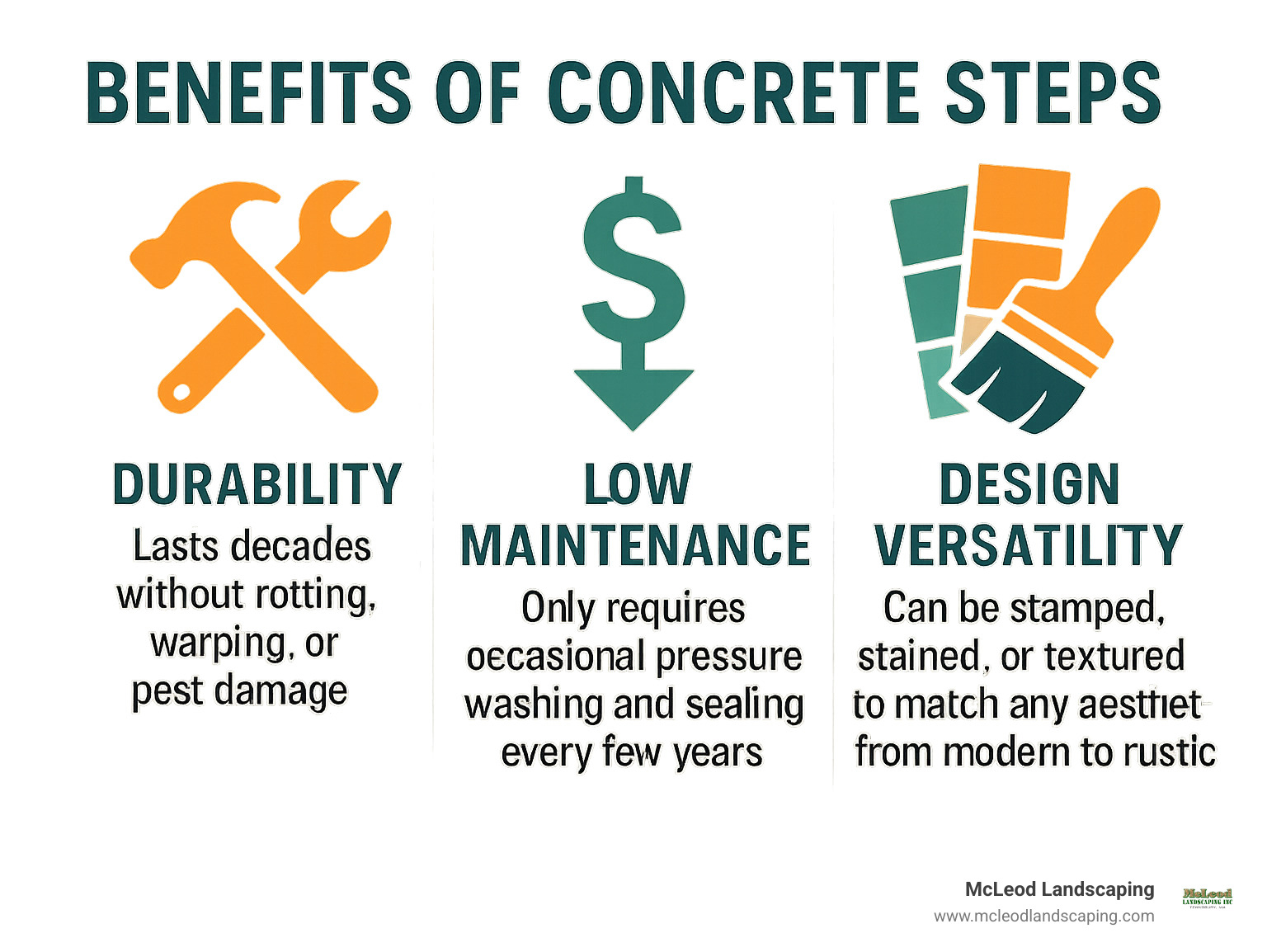
Backyard concrete steps offer a perfect mix of durability, affordability, and design flexibility. Whether connecting different yard levels or accessing patios, concrete steps are a durable, low-maintenance solution that can last for decades.
Quick Answer: Building Backyard Concrete Steps
The benefits are clear. One DIYer built a 30-foot staircase for under $1,000, saving massively on professional quotes of $15,000-$20,000.
Unlike wood or stone, concrete resists weather, pests, and wear. It won’t warp, fade, or splinter, requiring only occasional pressure washing. Based on average internet data (not McLeod Landscaping’s actual pricing), professional installation costs typically range from $1,000 to $5,000 depending on complexity, but a DIY approach offers significant savings and satisfaction.
The versatility of concrete allows for endless customization. You can mimic stone, brick, or wood through stamping and staining, while the naturally slip-resistant surface provides crucial safety.
I’m Scott McLeod of McLeod Landscaping. With over 30 years of experience in the Merrimack Valley, I’ve installed countless backyard concrete steps. Whether DIY or pro-installed, they are a smart investment for your outdoor space.
Backyard concrete steps terms you need:
Proper planning is the foundation of a successful concrete steps project, saving you time, money, and frustration. A successful project requires understanding your site, budget, materials, and safety regulations. Skipping this phase often leads to poor results.
Proper step dimensions are crucial for comfort and safety. Steps should feel natural to walk on, and consistency is key—even a half-inch difference between steps can be a tripping hazard.
Step rise and run are the backbone of comfortable stairs. The rise is the height of each step, and the run is its depth.
The 7-11 rule is a good starting point: a maximum 7-inch rise with at least an 11-inch run. For optimal comfort, consider these ratios: a 4 to 4½-inch riser works well with an 18 to 19-inch tread, while a 6 to 6½-inch riser pairs perfectly with a 14 to 15-inch tread. Most homeowners find tread widths between 10 and 13 inches with riser heights of 6 to 8 inches feel most natural.
Tread depth is especially important for outdoor steps, ensuring users feel secure, especially when carrying items.
Landings for long stairways are not just code requirements; they are rest stops that improve safety. If your steps cover more than 5 feet of vertical distance, plan for landings at least 3 feet wide.
Slope for drainage is essential. A simple ¼-inch forward slope per foot prevents water from pooling, which can cause slip hazards and freeze-thaw damage.
Overall shape and size offer exciting possibilities. Straight steps suit modern homes, while curved steps can soften a landscape and complement traditional architecture. Consider how your steps will flow with your existing yard.
Concrete steps are budget-friendly. Understanding material needs helps you choose between DIY and professional installation.
DIY material costs under $1,000 make concrete steps an attractive option for budget-conscious homeowners.
Professional installation cost ranges vary based on complexity and location. Based on internet data (not McLeod Landscaping’s actual pricing), expect $1,000 to $4,000 for standard installations, though intricate designs with stamping or coloring can push costs over $5,000.
Bagged concrete mix is the core of most DIY projects. Standard 60-pound bags cost around $5 to $7 each. Calculate your needs carefully and add 10% extra for waste.
Gravel base provides a crucial foundation to prevent settling. Stone dust or sand can also work, depending on your soil.
Rebar for reinforcement dramatically extends your steps’ lifespan by preventing cracking.
Lumber for forms requires sturdy materials like 2x4s, 2x6s, 2x8s, or plywood to hold the concrete while it cures.
Understanding local safety regulations upfront prevents costly mistakes and protects your family and investment.
Local building codes vary, so check with your local building department before starting. What’s acceptable in one town might not be in another.
Handrail requirements typically apply to stairs with three or more steps. Required handrails usually need to be 34 to 38 inches high and securely anchored.
Slip-resistant surfaces are vital. Smooth concrete becomes slippery when wet; we’ll cover texturing techniques later to create safe surfaces.
Accessibility standards primarily apply to commercial properties, but incorporating features like 36-inch pathway widths benefits everyone.
Proper lighting for nighttime safety prevents falls. Subtle lighting along or within your steps can illuminate the path without harsh glare.
With planning complete, it’s time to build your backyard concrete steps. This process requires careful preparation, timing, and patience to achieve beautiful, lasting results.

Meticulous site prep and solid forms are the foundation of a great concrete project. Don’t cut corners here.
Excavating the area is your first step. Remove all soil, debris, and old materials, digging 4-6 inches below your planned finished grade.
Next, create a compacted gravel base. Fill the excavated area with stone dust, sand, or gravel. This layer prevents shifting from freeze-thaw cycles. Compact it thoroughly with a hand tamper or plate compactor for long-term stability.
Building sturdy forms is where your carpentry skills shine. Use lumber like 2x4s, 2x6s, or plywood to create a mold for your steps. Pro tip: Use screws instead of nails for forms. They’re easier to disassemble, and the lumber can be reused.
Brace forms to prevent blowouts. Wet concrete is heavy and can push forms apart. Brace them thoroughly, both vertically and horizontally, to prevent a disastrous pour.
For an neat touch, consider using form liners for decorative edges. These can create curved profiles or mimic natural cut stone.
This phase requires good timing and organization. Have all your tools ready: shovel, wheelbarrow, level, trowels, and edger, plus safety gear.
Mix concrete to the right consistency. Aim for a thick, oatmeal-like texture. For the Massachusetts climate, a 4000 psi air-entrained mix is essential to resist freeze-thaw cycles and salt damage.
Always start pouring from the bottom step up. Working uphill is practical, helping manage runoff and ensuring each step fills completely. Overfill slightly to account for settling.
As you pour, insert rebar for strength. This steel reinforcement gives your concrete a backbone and prevents cracking. If attaching to existing structures, tie the rebar together.
Don’t forget to remove air pockets. Gently tap the forms and poke the concrete with a stick to release trapped air, which can create weak spots.
In this final phase, your backyard concrete steps become a beautiful, functional feature.

Screed the surface level first. Drag a straight 2×4 across the forms in a sawing motion to remove excess concrete.
Next, float to smooth imperfections. Use a hand float to smooth out rough spots and bring the fine cement “cream” to the surface.
Edge for clean, chip-resistant corners once the concrete begins to stiffen. An edging trowel creates rounded, professional-looking corners that resist chipping.
For safety, apply a broom finish for texture. Once the concrete can support the broom’s weight, gently pull it across the surface. These grooves are crucial for slip resistance on wet or icy steps.
The curing process is vital. Concrete cures through a chemical reaction. Keep it moist for 24-48 hours with plastic sheeting or misting. This slow cure is vital for maximum strength.
After 24-48 hours, you can carefully remove the forms. The steps will continue to gain strength over the next few weeks but can be used gently after a few days.
Once built, your backyard concrete steps offer many customization options and require very little maintenance over their long lifespan.
Concrete’s versatility allows it to mimic almost any material. You can create steps that look like natural stone, weathered wood, or become an artistic focal point.

Stamped concrete patterns can dramatically change the look. Use stamps or rollers on workable concrete to mimic slate, flagstone, or wood. Timing is key: stamp when the concrete is firm enough to hold the pattern but still soft enough to take an impression.
Color options add creative freedom. Integral colors mixed in provide fade-resistant color, while acid or water-based stains applied after curing create variegated effects. Choose from earth tones that blend with the landscape or bold colors for an architectural statement.
Exposed aggregate finishes create a textured, natural look. By washing away the top layer of cement paste before it fully hardens, you reveal the decorative stones within the mix, creating a beautiful and highly slip-resistant surface.
Integrate your steps with your overall hardscape designs and plantings. They should flow naturally into patios and walkways. Nearby plantings can soften the edges and create a welcoming path.
Backyard concrete steps are a smart, low-maintenance investment. Unlike wood or stone, properly installed concrete performs for decades. You can expect a lifespan of decades with minimal care. They resist warping, splitting, and pests, making the initial investment worthwhile.
Routine cleaning is simple. A pressure washer once or twice a year removes dirt and moss.
Sealing your concrete every 2-5 years is the most important maintenance task. It protects against moisture, stains, and deicing salts, keeping steps looking fresh and extending their life.
If minor cracks appear, they are usually easy to repair with concrete crack fillers. Catching them early prevents bigger problems.
The environmental benefit of a long-lasting material is significant, as it reduces waste and the demand for new materials.
The choice between DIY and hiring a pro depends on your comfort level, time, and project complexity.
DIY projects offer substantial cost savings, with materials often under $1,000. However, the time commitment can be significant, especially for larger projects. The skill level required varies; basic steps are manageable, but you must plan carefully. With proper planning, final quality can be excellent, but inexperience carries risk.
Professional contractors bring experience and specialized tools, ensuring a flawless finish. They can handle far greater project complexity, such as curved steps or multiple landings.
Call a professional for intricate curves, significant elevation changes, or complex drainage issues. With over 30 years of experience in the Merrimack Valley, McLeod Landscaping knows how to avoid common pitfalls that can plague DIY projects.
Common installation problems like improper base preparation or incorrect mix ratios can lead to cracking and failure. Professionals prevent these issues, ensuring your investment lasts.
With three decades of experience, I’ve heard every question about backyard concrete steps. Here are answers to the most common ones.
Properly built backyard concrete steps are incredibly durable, lasting 50 years or more with basic care. This is two to three times longer than wood steps, which often fail after 10-15 years due to rot and pests.
What makes concrete so durable? It doesn’t rot, warp, or attract termites. Properly installed concrete steps can withstand harsh New England winters, including freeze-thaw cycles and road salt.
The secret to their long life is simple: a good pressure washing once a year and sealing them every few years to protect against moisture and stains. This contrasts with wooden steps, which require constant maintenance.
For durable backyard concrete steps, start with the right mix. We recommend a high-strength mix of at least 4000 psi. Stronger concrete means longer-lasting steps.
The water-to-cement ratio is also crucial; less water means stronger concrete.
In Massachusetts, air-entrained concrete is essential. These microscopic air bubbles are crucial. When water in the concrete freezes and expands, the bubbles provide space, preventing cracks. Most suppliers offer exterior-grade mixes with air-entrainment.
While it seems like a time-saver, building new concrete steps over old ones is a bad idea.
Old steps likely can’t support the extra weight, leading to settling, cracking, or failure. This can ruin your new steps within a few seasons.
Drainage becomes a nightmare, as trapped water between the layers can freeze and cause structural damage. Getting new concrete to properly bond to old concrete is also difficult, and delamination (layer separation) is a common problem.
The smart approach is to completely remove the old steps and start fresh with proper site preparation. It’s more work upfront, but it ensures your steps will last for decades. In my 30 years of experience, I’ve seen this shortcut fail many times.
Backyard concrete steps are a rewarding home improvement project, offering durability, low maintenance, and design flexibility to transform your outdoor space.
This guide covered everything from planning and site prep to pouring and finishing your concrete steps. We’ve explored the exciting customization possibilities, like stamping or exposed aggregate finishes, that make concrete a superior choice. The financial benefit is also significant, with a DIY project often costing under $1,000 in materials compared to professional quotes that can exceed $15,000.
Your backyard concrete steps will be a lasting, low-maintenance addition that improves your property’s value and provides peace of mind. They are a testament to your craftsmanship (if you DIY) or a professional upgrade that will serve your family for years.
At McLeod Landscaping, we’ve been helping homeowners throughout the Merrimack Valley create stunning outdoor spaces for over three decades. From Andover to Wilmington, we’ve seen how the right hardscaping can transform a backyard into a true outdoor oasis. Our experience with residential hardscaping means we understand the technical and aesthetic requirements that make each project unique.
Whether you choose a rewarding DIY adventure or prefer to work with experienced professionals, your new concrete steps will serve your family well for generations. Ready to take that next step? Transform your backyard with our professional walkway and stair installation services and let us help turn your vision into reality.
Contact McLeod Landscaping today at (978) 640-0957 or click here to schedule a consultation for retaining wall installation. Let our experienced team design and install a functional and visually appealing retaining wall that enhances your landscape.


1881 Main St Unit 1, Tewksbury, MA 01876